

MODULAR ROBOTIC WORK CELLS
Engineered to Scale with Your Production
Flexible | Integrated | Robotic | Modular
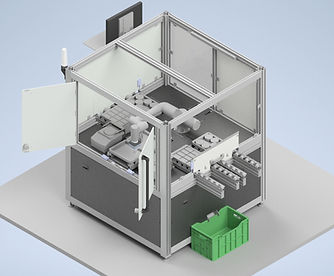
EIS Automation’s modular robotic work cell platform delivers flexible, scalable automation built to fit your production needs. Using a standardized design methodology, each work cell can be configured, expanded, or redeployed as requirements evolve. This enables seamless integration into existing processes while reducing implementation time and cost. The result is a reliable, efficient solution that grows with your operation and supports your long-term automation strategy.

CONFIGURE
Our modular configurations—linear, L-shape, U-shape, and parallel—provide flexible layouts, scalable capacity, and seamless integration to fit any production need, including industries such as life sciences and clean room environments.
Easily adapt, expand, or reconfigure your system to optimize space, improve flow, and increase efficiency—delivering a future-ready solution that supports your long-term automation strategy.
IPO Principle
Our modules follow an
Input–Process–Output (IPO) design principle to ensure consistent product flow. Products enter at a defined input point, are automatically processed within the controlled environment of our cell modules
and exit at a designated output
point ready for the
next production step.
This structured approach drives consistency, efficiency, and
reliable performance.


FROM IDEATION TO REALITY


KEY BENEFITS
As more and more businesses are stepping into industry 4.0, robotic work cells are becoming an easy-to-integrate and accessible way to improve industrial operations and overall productivity.
1
Reduced Labor Costs
One of the biggest benefits of integrating robotics into your manufacturing is a reduced labor cost. As many business owners know, finding labor can be difficult and time-consuming. A workcell can maintain or increase product output, without any additional hiring needed.
2
Reduced Purchasing Costs
Purchasing a pre-designed and pre-engineered workcell is significantly more cost-effective than a completely unique and customized robotic solution. At EIS Automation, we use modular technology that allows us to use our pre-engineered workcell to keep costs competitive, while offering customization to scale the work cells to the individualized sizes and capabilities needed to meet your industrial needs.
3
Maximized Efficiency
An important benefit of integrating robotics into your manufacturing process is that they have an incredibly high degree of accuracy and repeatability that is impossible to achieve through human-only labor. 3 Maximized Ef
4
Increased
Safety
Any time a large, quick-moving unit is added to the manufacturing floor, the opportunity for accidents can increase. However, workcells are specifically designed to complete their process in an enclosed space which limits the opportunity for accidents. Additionally, our workcells are equipped with interlocks to automatically stop the equipment if an operator accidently opens the work cell during production.
5
Increased Product Throughput
Workcells are designed to work quickly and efficiently. They can increase your product throughput via reduced downtime and increased production rate. Robots are able to complete tasks more efficiently than an employee due to human nature and error.